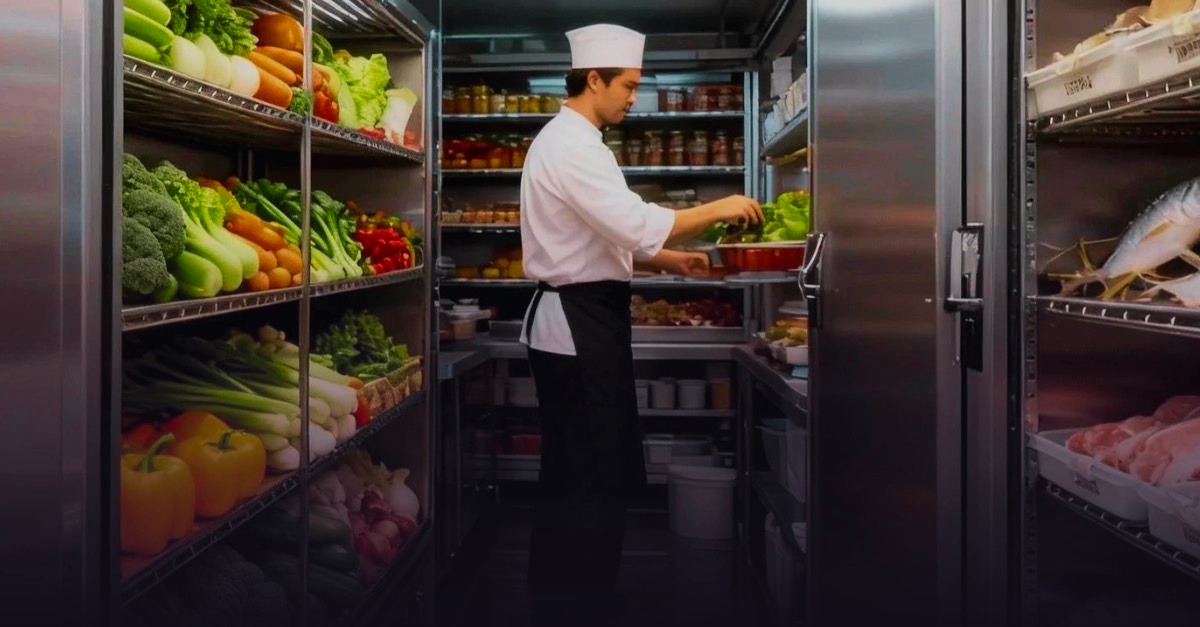
Manual temperature logs have long been the standard for documenting food safety in restaurants. And while these manual temperature logs might provide a snapshot of one moment in time, they can’t tell you what happened during the other 23 hours of the day. Every operator has experienced some version of this scenario:
Someone checks the walk-in at open. They write down a number and move on with the day. They figure, “It looks fine, so it must be fine.” But here’s the thing: one number, checked once, tells you almost nothing about the hours that preceded or followed that temperature check; hours when temperatures may have drifted outside a safe range.
The stakes here are significant. The CDC puts the annual cost of foodborne illness in the U.S. at roughly $17.6 billion, and over half of the outbreaks reported in a given year trace back to restaurants, delis, and similar food service settings — not some far-off supply chain problem.
Why Manual Temperature Logs Miss the Biggest Risks
Most temperature variations actually don’t happen during business hours. They happen overnight, on a quiet Sunday, over a long weekend, whenever a compressor starts struggling or a door doesn’t latch or a circuit breaker trips and there’s nobody around to notice. By the time a manager opens for business and takes a reading the next morning, the damage is already done. Food’s been sitting at an unsafe temperature for hours. By the time someone checks the temperature the next morning, the unit may have recovered. The number on the clipboard looks perfectly normal, even though food may have spent hours in the danger zone overnight.
Why does a short gap matter this much? Well, it’s mostly biology. The USDA’s Food Safety and Inspection Service defines a “Danger Zone” between 40°F and 140°F where bacteria can double in as little as twenty minutes. Consider this happening multiple times over a few hours and a small, harmless blip can turn into a real problem.
A one-time manual entry is just a snapshot, nothing more. It tells you the temperature at the exact second someone wrote it down. But there’s nothing about a 2am temporary power outage. Nothing about the two hours the walk-in door didn’t latch after a delivery. And if a health inspector ever asks what happened in between, “we don’t know, we weren’t looking” is not the answer anyone wants.
Why this keeps happening even at well-run locations
Even the best, most disciplined and conscientious manager can only check what they’re physically there to check. A system built around periodic manual temperature logs will always have blind spots no matter how diligent any manager or employee might be; and the blind spots only increase as you add locations.
Summer is the toughest time of year for these kinds of gaps. Multiple studies show cold-holding violations spike in July and August as the outdoor heat pushes walk-ins and reach-ins past what they’re built to handle. Higher ambient temperatures force refrigeration systems to work harder, making small equipment problems more likely to turn into major temperature excursions.
And we’re not talking about hypothetical examples. One refrigeration failure can mean thousands of dollars in discarded product, a violation write-up, or, in the worst case, an illness event that turns into a headline and months of bad PR for your business.
What closing the gap actually looks like
What if you could eliminate the manual temperature logs and remove all those time gaps where you can’t track a temperature? FDA guidance written for regulators says plainly that continuous temperature monitoring beats periodic manual checks, full stop. It’s the only thing that gives a complete picture of what happened at a critical control point over time.
Continuous temperature monitoring means sensors automatically logging temperature around the clock and flagging exceptions the moment they happen. Instead of relying on manual temperature logs, managers receive a complete record of every temperature reading, including alerts when a unit moves outside acceptable limits. This turns a once-a-shift guess into an actual record. Ladle’s ComplianceMate runs on LoRaWAN sensors reporting every ten minutes, so an excursion gets caught and teams are alerted quickly instead of discovering the issue the next morning. Customers running this solution have seen HACCP-related labor drop significantly, mostly because nobody’s manually logging numbers any longer.
The real question was never whether the walk-in was fine this morning. It was what happened while no one was watching; and whether you would ever know.
For more information, check out our free guide to Temperature Monitoring.
Sources:
CDC, “About Restaurant Food Safety”
USDA Food Safety and Inspection Service, “Danger Zone (40°F – 140°F)”
Ecolab, “Turning HDI Data into Sustainable Food Safety Improvements”
FDA, “Managing Food Safety: A Regulator’s Manual for Applying HACCP”